Exhibition Catalog & Price Booklet
Exhibition Catalog & Price Booklet
-
My grandparents were cultivators. Among their children and grandchildren, they filled their backyard with all the beauties of Eden. Peach and tangerine trees filled the yard, grape vines and tomatillo plants lined the fences, and flower beds on the patio grew saplings from discarded pits. Where they threw seeds, sprouted roots of their identity, and eventually mine. Among these many plants, the nopal and pomegranate are two that carry profound significance.
As a child, I was never quite fond of the prickly pear. I found it a daunting plant amongst the fruit trees. It was something that felt unsafe to play around and its bitter taste also added to my dissatisfaction with the plant. Their thorns and guarded nature carry a sense of emotional armor, distance, and defensiveness. These are feelings often present in a traditional Hispanic and Catholic household. As the only son, I was exposed to the quiet and sometimes loud pressures of machismo culture. Those beliefs normalized physical and verbal aggression, homophobia, and a lack of emotional support. Being in the closet for a large portion of my life, I felt a need to compensate for my sexuality by putting on a facade. Much like the nopal, I kept my sexuality guarded. I suppressed my emotions as best as I could because I couldn’t appear “weak” in front of others.
Despite this, I cried a lot as a child. I do not let this shame stop me from crying now. I was brought up with the notion that vulnerability was weakness, but I’ve learned the strength in acknowledging these parts of my identity. It has taken some time, but I've grown to love the nopal. Not for its taste, but for all that it stands for. They embody the strength it takes to grow even in harsh conditions. They are sacred reminders of resilience and nourishment, and as I continue to develop my identity, they serve as a connection to my roots.
My emotional experiences are also tied to the pomegranate. It is a fruit that is guarded by a tough exterior, yet weeps a sweet and heavy nectar when exposed. At its core, the pomegranate is my heart. It bleeds, loves, aches, and its many chambers house my memories. It contains an experience that many children growing up in first generation and immigrant households may be familiar with. The displays of love we may expect from family members, such as verbal affirmations, physical affection, and emotional vulnerability, are not always expressed in recognizable ways. It is often found in long hours worked, meals prepared, and even in the tender act of cutting fruit. This gesture is generational. It was a simple and quiet ritual that my grandparents performed. They picked, cut, and prepared the fruit that nourished my sister and I. It was a small but intimate way of showing their love for us. It transcended the language barrier and the emotional distance that was often found in my household.
Together, nopales and pomegranates serve as a tribute to the people who shaped me, the culture that grounds me, and the love I cultivate. For much of my life, I suppressed my identity and believed I was unworthy of love and incapable of coming out of the closet. I’ve learned to cut fruit and offer the same tenderness that I deprived myself of for 22 years of my life.
-
Jose Soria is a multidisciplinary artist whose work examines the intersections of religion, sexuality, and cultural identity through memory-based and material driven practices. Rooted in his upbringing in California’s Central Valley, Soria’s work engages multiple forms of displacement, including physical, cultural, emotional, and spiritual, using them as frameworks to explore resilience, intimacy, and belonging.
Drawing from a background shaped by Catholicism, familial gardens, and growing up closeted within a traditional Hispanic household, Soria incorporates religious iconography, domestic materials, and figurative imagery across painting, assemblage, and woodworking.Through an embrace of vulnerability as a critical and generative force, his work holds contradiction, including faith and doubt, devotion and resistance, tenderness and tension, allowing private memory to become collective experience. These inquiries into inherited belief systems, generational trauma, and the construction of identity ultimately frame the body as a site of connection, grief, love, and transformation.
Please contact Jose Soria at @artistjosesoria@gmail.com for more information
SOLD $1,875
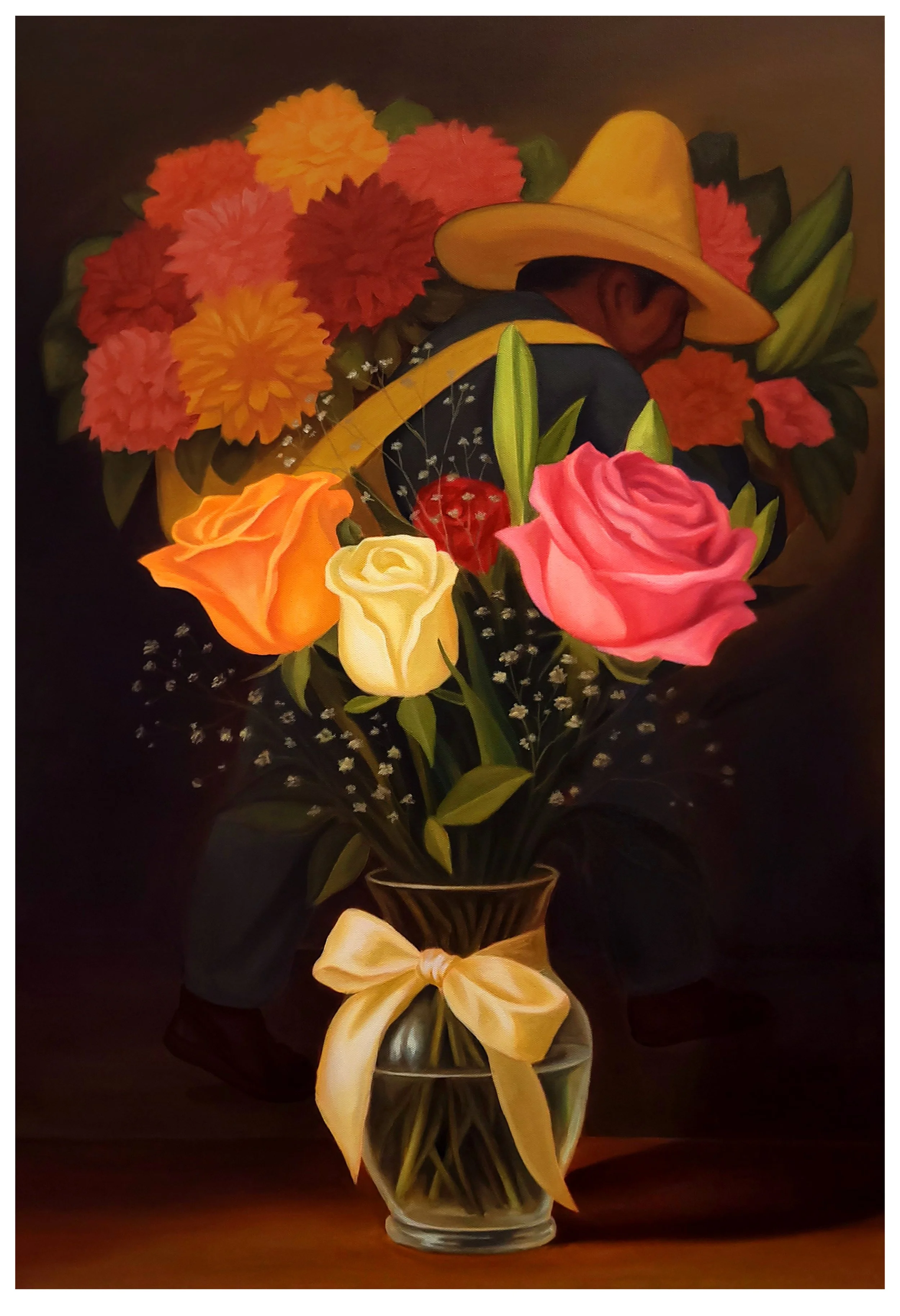
The weight of flowers
Oil on canvas, constructed frame
36” x 25 1/2”
2025
$2,500
Soy la fruta de las heridas y la sanación
Oil on canvas, ink on paper, espinas, pomegranate seeds, soil, found objects, constructed frame triptych
25 3/4” x 29 1/4”
2025
SOLD $1,500
Our daily bread
Oil on canvas
29 3/4” x 23 3/4”
2025
SOLD $1,250
Nopal
Oil on canvas, constructed frame
25 1/2" x 17 1/2”
2025
$1,250
Néctar
Oil on canvas, constructed frame
25 1/2" x 17 1/2”
2025
$2,500
False Prophet
Oil on canvas, barbed wire, found objects
25 1/2” x 26 1/2”
2025
SOLD $1,875
All that I am
Oil on canvas, constructed frame
30” x 40”
2025
SOLD $1,875
Mi Corazón es Rojo, Tu Corazón es Verde
Oil on canvas, constructed frame triptych
36” x 50”
2025
NFS
La casa que me creó
Oil on panel, constructed frame
26 1/2” x 24 1/2”
2025
$2,500
I commune with my heart in the night
Oil on canvas, blood, ash, confessional water, rosary, dried flowers, communion wafer, crosses, constructed frame
27 3/4” x 19 3/4"
2024
NFS
My existence is a scandal
Oil on canvas
27” x 23”
2022
NFS
Self Portrait (with nopales)
Charcoal on paper
29 3/4” x 23 3/4”
2024
NFS
Saint Soria
Oil on canvas
30” x 24”
2023
$1500
Sunshine
Oil on panel
26” x 26”
2026
$1500
Thorns
Oil on panel
26” x 26”
2026
NFS
Memories of my youth
Installation
Dimensions vary
2024